Wednesday, December 9, 2009

Todays Math Class

In todays math class we found the are of G C I F

C, D, I, E = 25m

I, F, E = 12.5m squared

A, H, B = 40m squared

B, C, H, G = 70m squared

C, G, F, I, = 52.5m squared

The area of the Rectangle is 200m squared


Percent
30% means 30 out of 100

Percent is a fraction out of 100 or a denominator of 100

____
100

eg. 30% = 30 = 0.30
___
100


We can use money skills to think of fraction decimal percent


something something something
_______ ________ ________
something 1 100


25 50 10
____ ____ ___
100 100 100
(25%) (50%) (10%)


Find 50 % of $84.60 = $42.30

Find 25% of $84.60 = $21.23

Find 10% of $92.30 = $ 9.23

Find 50% of $45.80 = $22.90

Find 25% of $ 50.00 = $ 12.50

Find 10% of $72.40 = $7.24


Using a ratio table find 37.5% of 120


HOMEWORK


Using the ratio table find:

75% of 16

60% of 90

40% of 80


Tuesday, December 8, 2009

The Half and Differences between Numbers


The whole numbers that are between 7 and 13 are 8, 9, 10, 11 and 12.
The difference between 13 and 7 is 6.
13 - 7 = 6
Half of this difference is 3.
6 divided by 2 equals 3.
The number 10 is halfway between 7 and 13.
Like this:

7 + 3 = 10
Or...
13 - 3 = 10

Finding a halfway between numbers.

You can add the given numbers and divide it by two.
Like this..

70 and
170
70 + 170 = 240
And divide it by two. It equals
120.


And:


If you don't get it still, look at these examples we did during class...

1. What are the whole numbers between these given numbers?
68 and 72: The answer would be 69, 70, 71.
108.3 and 111.6: The answer would be 109 and 110

How? If you think of it as the alphabet, like, A B C, you know that
B is in between A and C.


Thursday, November 26, 2009

Area

Area(a)- the number of square units contained in a two dimensional shape and also is the surface space a shape takes up..
Example:


Area of square and rectangle>>> Length x Width = Area


Parallelogram-
a four figure with opposite sides, parallel and equal

Example:
Height(h)- the perpendicular distance from the base to the opposite side.

Example:
Base(b)- side of a two dimensional closed figure.(SHAPE)

Example:

AREA OF PARALLELOGRAM
A=B X H


(b) is 5 cm and (h) is 3cm. Plug there values into a formula...

A = B X H

A= 5 x 3

A= 15cm


http://www.youtube.com/watch?v=KVFwRA7kcLY

Monday, November 23, 2009

ANGLES

ANGLES


- Space Between Two Connection Lines

eg.


CUTE ANGLE


- An Angle That Is Less Than 90 dg.

eg.


Obtuse Angle


- An Angle that is greater than 90 dg. and less than 180 dg.

eg.


Right Angles


-Exactly 90 dg.

eg.


Straight Angle


- Exactly 180 dg.

eg.


ANGLE BISECTOR

- The Line That Divide And Angle In Two Equal Parts

- Equal Angles Are Marked With The Same Symbol dg.

eg.


HOW TO MAKE A ANGLE BISECTOR


1. Fold Paper


eg.


Method 2. Use Compass Make An Are From The Vertex That Crosses Both Arms.

LABEL THEM X,Y


2. Make An Are From Point X and Y They Must Be Equal Size.

3. Draw A Line From Point B To The Are Intersection.

eg.


Method 3. Use A Protractor

1. Measure The Angle DEF 140 dg.


2. Divide Your Angle Measurement By 2

140 dg. Divided By 2 = 70 dg.


3. Make A Mark At 70 dg. Using Protractor Labeled Q


Y. Join Point Q With The Vertex With A Straight Line


eg.


Wednesday, November 18, 2009

Bisecting Perpendicular Lines


Bisect-

Bi means two.
Sect means cut.
So if you put it together, bisect means to cut in two.


Perpendicular
Bisector-
A perpendicular bisector is a line that divides another line segment in half and is at right angles or 90 degrees.
Remember that equal line segments are marked with "hash" marks.


Ways to Make a Perpendicular Bisector:

- Use a right triangle.
- Use a ruler.
- Use a compass

1. Make an arc from point A that is greater than half way.
2. Make an equal sized arc from point B.
3. Connect the arc intersections with a straight line. That line is a perpendicular bisector.


Here is a video for all of you to enjoy and hopefully it will help you understand bisecting more.


** Today's Homework**
Draw a 12 centimeter line segment and label it PQ. Draw the perpendicular bisector of this segment using all three ways. Label the point where they intersect R.

Remember that there is going to be a test tomorrow on perpendicular, parallel and bisecting line segments. So everyone please study hard.(:


Please comment on my blog and please point out any mistakes I made.

Tuesday, November 17, 2009

How to Draw Parallel and Perpendicular Lines

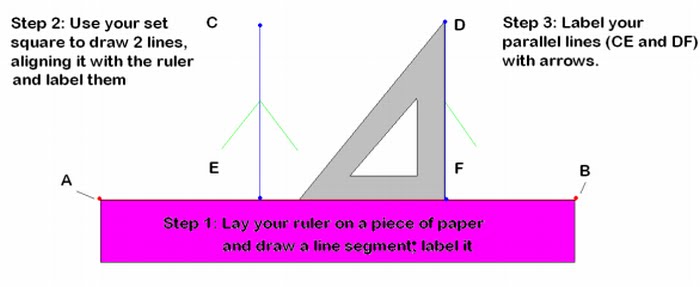
How to Draw Parallel Lines

  1. fold and label paper like so:


  2. use a ruler and set square like so:


How to Draw Perpendicular Lines


  1. fold paper like so:


2. use protractor like so:


Remember...
Pages 86-88 #1-16 is HOMEWORK!!!
Here is a quick link to save you the trouble of typing.

If you still have trouble with perpendicular lines, here's a video.


Monday, November 16, 2009

Parallel and Perpendicular lines

Parallel and Perpendicular lines


Geometry- shapes and measurements.


Parallel- describes two lines in the same plane that never cross, or intersect.


- they are marked using arrows.


Perpendicular- describes lines that intersect at right angles. ( 90°)


- they are marked using a small square. ________________________________________________________________


measure the diference from:


A to B


B to C


E to F


F to G


I to J


J to K


they all are 8.9 cm.


_________________________


identify any parallel lines you can find.


AE // BF, EI // FJ, CG // BF, GK // JF, AI // CK

what d0 you notice about parallel lines? they always are the same distance apart no metter where you measure, as long as you measure a perpedicular line.

identify any perpendicular line segments.

AE __ DF , FE __ AI , BF __ EG , CG __ FH

What do you notice about perpendicular line segments? they all meet at 60° angles.

*****************************************************************************

here is a link to a video i watched about line parallel and perpendicular lines.

http://www.youtube.com/watch?v=Rew54K6mYUo

__________________________________________________________________

*HOMEWORK*

#1. Are line segments AC and DF parallel?

#2. Are line segments DF and BE perpendicular?

#3. Are line segments AC and BE perpendicular? How do you know?

#4. Would a line segment joining A to D be parallel to a line segment BE? How do you know?